
← The Ultimate Guide to Inventory Accuracy
Annual Physical Inventory vs. Cycle Counting: Which is Best?
Every business reaches a crossroads where they must decide how to verify their stock levels. Traditionally, the "Annual Physical Inventory" was the gold standard, a massive, once-a-year event. However, as supply chains become leaner, "Cycle Counting" has emerged as a powerful alternative. Choosing the right one for your business depends on your volume, your staff, and how much downtime you can afford.
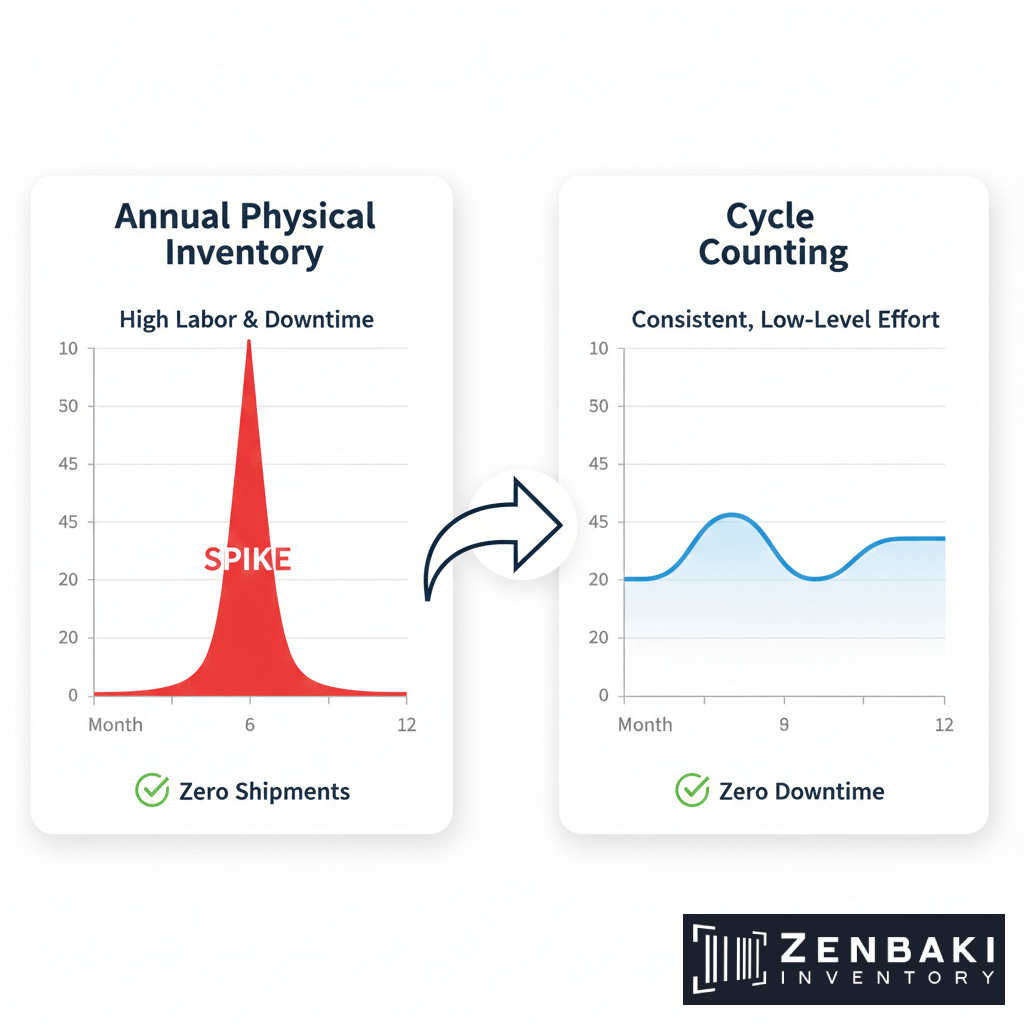
What is a Full Physical Inventory?
A physical inventory is a comprehensive audit where every single item in the facility is counted at once. This usually happens at the end of the fiscal year for tax and accounting purposes. It provides a "clean slate" for your books but often requires a total operational shutdown.
The Pros: It provides a definitive valuation for stakeholders and satisfies most rigorous financial audit requirements in one go.
The Cons: It is exhausting, prone to human error due to the sheer volume of data, and halts revenue-generating activities.
What is Cycle Counting?
Cycle counting is a sampling technique where you count a small portion of your inventory every day or week. Over the course of a year (the "cycle"), every SKU is eventually counted at least once. High-value items might be counted monthly, while low-value items are counted once a year.
The Pros: There is zero operational downtime. Errors are caught and corrected in real-time rather than waiting 12 months to find a discrepancy.
The Cons: It requires a disciplined, dedicated team to stay on schedule. If you miss your "cycles," your data integrity collapses quickly.
Key Differences: Accuracy and Stress Levels
The biggest difference is the "Error Correction Window." In an annual count, if a pallet went missing in February and you count in December, you have ten months of bad data affecting your purchasing decisions. With cycle counting, that error would likely be caught within weeks. Furthermore, the "stress spikes" associated with annual counts often lead to sloppy data entry, whereas cycle counting makes auditing a calm, routine part of the workday.
Hybrid Models: The Best of Both Worlds
Many high-growth companies utilize a hybrid approach. They employ a professional inventory service to perform a "Wall-to-Wall" count once a year to satisfy tax requirements, and then use cycle counting internally throughout the year to maintain day-to-day accuracy. This ensures the warehouse stays organized and the year-end audit is fast and painless.
Which Should You Choose?
If you have high turnover and a complex warehouse management system (WMS), cycle counting is almost mandatory for modern efficiency. However, if you are a smaller operation or need a certified valuation for a bank or auditor, a professional annual physical count is the safest bet for total compliance.